In football, thirty years is almost unimaginable.
Managers are judged after a handful of poor results. Owners come and go. Chairmen often arrive with ambitious plans before quietly disappearing a few years later. Stability has become one of the rarest commodities in the modern game.
At Sutton United, however, stability has had a name for the last three decades.
This month marks thirty years and one month since Bruce Elliott became Chairman of Sutton United, making him the longest-serving chairman in the club’s history. During that time he has overseen promotions, relegations, an unforgettable FA Cup run, three seasons in the Football League and the most successful period the club has ever experienced. More importantly, he has helped preserve the values that made Sutton United special long before national television cameras arrived at Gander Green Lane.
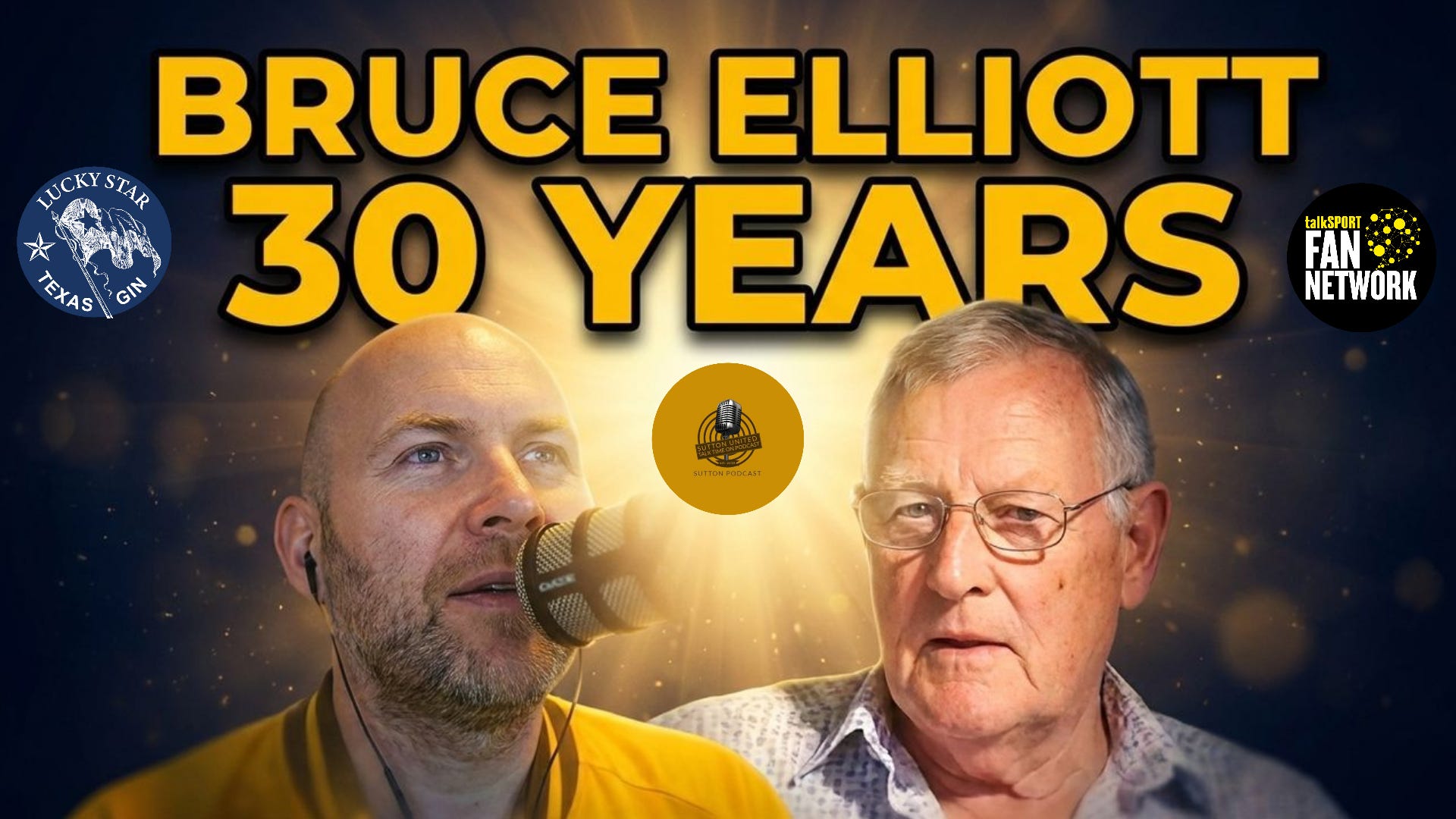
To mark the occasion, Bruce joined me on the Sutton Podcast for a conversation that became less about individual matches and more about the remarkable journey of both a football club and the man who has guided it for thirty years.
Bruce’s story actually starts long before he became chairman. Like so many Sutton supporters, he first came to Gander Green Lane as a young boy with his father during the early 1960s. His love for the club naturally evolved into volunteering through the Supporters’ Club before moving onto the management committee and eventually becoming assistant secretary under the much-loved Ralph Carr. Becoming chairman wasn’t something he spent years planning or campaigning for. In fact, it almost happened by accident.
His predecessor, Dave Hermitage, persuaded him to become vice-chairman with what Bruce now laughs was one of football’s greatest sales pitches.
“It won’t entail any more work than you’re already doing.”
Anyone who has ever volunteered at a football club will probably smile at that line. We all know how those conversations end.
Following Dave’s untimely passing, Bruce was asked to take over as chairman. He accepted, imagining it might be for a few years until somebody else came along. Thirty years later, he is still in the chair, having become the longest-serving chairman the club has ever had.
Listening to Bruce speak, one theme continually resurfaced throughout the conversation. He never talks about Sutton United as though it was built by one person. Every achievement, every promotion and every milestone is quickly followed by praise for somebody else. Again and again he returned to the volunteers who kept the club alive through the difficult years.
When Bruce became chairman, Sutton United was an entirely volunteer-run football club. The management committee seemed to have a hand in everything, from organising matchdays to dealing with the day-to-day running of the club. Looking back, Bruce was keen to stress that while he chaired those meetings, the success of Sutton United was built by an extraordinary group of people who gave up countless hours simply because they loved their football club.
That volunteer spirit remains one of Sutton’s defining characteristics today. There are more staff now, larger budgets, bigger crowds and a completely different scale of operation, but Bruce believes the heart of the club has never changed. Even today’s Chief Executive, affectionately known to supporters as Tats, followed a familiar path. Supporter first, executive second. It is that continuity that Bruce believes has helped Sutton remain true to itself while climbing through the divisions.
One of the more charming stories from our conversation came from many years before Bruce ever became chairman. He recalled standing with Olive Evenden, wife of supporters’ club stalwart “Toffee” Evenden, when she looked at him and simply said, “Bruce, you’re going to be chairman of this club one day.”
He laughed it off.
After all, Sutton had enjoyed a succession of respected chairmen and Bruce couldn’t imagine ever following them. Looking back now, it feels almost like football folklore. Somehow Olive had seen something that Bruce himself hadn’t.
Of course, no chairman is remembered purely for longevity. Ultimately they are judged by the decisions they make, particularly when appointing managers. In that respect Bruce’s record is exceptional.
John Rains, Paul Doswell and Matt Gray each led Sutton through different chapters of its history, with every appointment helping move the club forward. Bruce spoke particularly warmly about Paul Doswell’s arrival following relegation in 2008. The story has become almost legendary within the club. Paul arrived for his interview but, as Bruce joked, it felt less like the board interviewing him and more like Paul interviewing the board.
His confidence was infectious.
His ambition was obvious.
His belief that Sutton could achieve something special never seemed to waver.
Bruce also revealed something that many supporters either never knew or have long since forgotten. Paul initially took on the role without taking a salary, refused to claim expenses despite travelling from Winchester and even helped introduce sponsorship that supported the club financially. Looking back now, it is difficult to imagine Sutton’s modern success without that remarkable partnership between chairman and manager.
As Sutton climbed through the divisions, football itself changed dramatically. Bruce reflected on how extraordinary it is that of all the clubs Sutton played alongside in the Isthmian League when he became chairman, only one now plays above Sutton’s current level, while several have disappeared from the football pyramid altogether. That simple statistic perhaps illustrates the scale of Sutton’s achievements better than any league table.
Naturally, our conversation eventually reached the FA Cup run of 2016-17.
Most supporters remember the goals, the television cameras and Arsenal arriving at Gander Green Lane.
Bruce remembers something rather different.
The workload.
Media from around the world descended on Sutton. Interviews started before breakfast and finished long after dark. The pressure of trying to run both a football club and a business eventually caught up with him. After the Arsenal game he was diagnosed with shingles, something his doctor attributed to the relentless weeks leading up to the biggest match in the club’s history.
Yet even amid the chaos, Bruce’s memories remain overwhelmingly positive. He spoke warmly about Arsenal as a football club, about the professionalism of Arsène Wenger and the genuine respect shown towards Sutton throughout the occasion. His recollection of apologising to Wenger for the modest dressing rooms, only for Wenger to reply that he actually preferred smaller dressing rooms because they kept players closer together, perfectly summed up the class shown by Arsenal that evening.
Of course, football is not built entirely on great memories.
Being chairman also means making the difficult decisions.
Bruce spoke honestly about asking Wayne Shaw to leave following the Piegate controversy and about the heartbreak of eventually parting company with Matt Gray after everything he had achieved. Those moments rarely make headlines in quite the same way as promotions and cup runs, but they form part of the responsibility that comes with leading a football club. Supporters celebrate the highs together, but chairmen often have to carry the lows alone.
As our conversation drew to a close, I asked Bruce perhaps the simplest question of the afternoon.
After thirty years, what has Sutton United given you?
His answer wasn’t about trophies.
It wasn’t about promotions.
It wasn’t even about the Football League.
Instead, he spoke about friendships, volunteers, shared experiences and the sense of belonging that football clubs at their very best create. He spoke about Jackie enjoying matchdays, about the countless people who have dedicated themselves to Sutton United and about a football club where people simply don’t seem to want to leave.
It was a beautifully human answer.
In many ways, it also explained why Bruce Elliott has remained chairman for thirty years.
For him, Sutton United has never simply been about winning football matches.
It has always been about people.
As supporters, we often measure history through league tables, promotions and famous cup ties. Bruce Elliott’s thirty years remind us that those moments are only possible because of the quieter work that happens behind the scenes, carried out by people who ask for very little recognition in return.
Thirty years after reluctantly accepting what he thought might be a temporary role, Bruce Elliott has become one of the defining figures in Sutton United’s history. The trophies, promotions and unforgettable nights will always be remembered, but perhaps his greatest achievement is ensuring that while the club has grown beyond anything anyone imagined in 1996, it has never lost sight of what made it special in the first place.
Share this post